





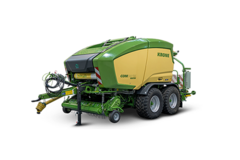
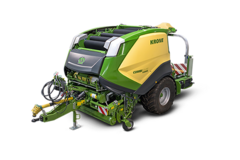
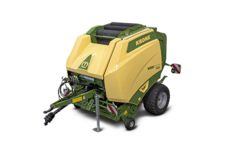
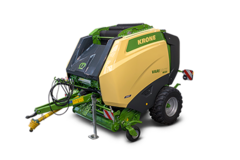
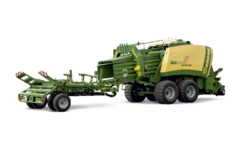
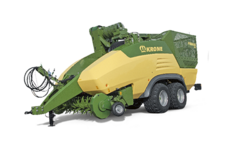
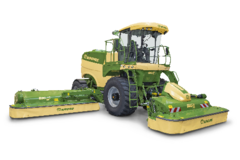
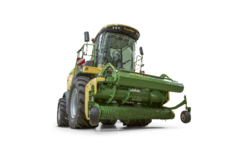
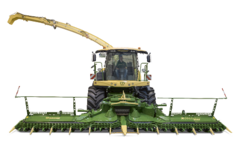







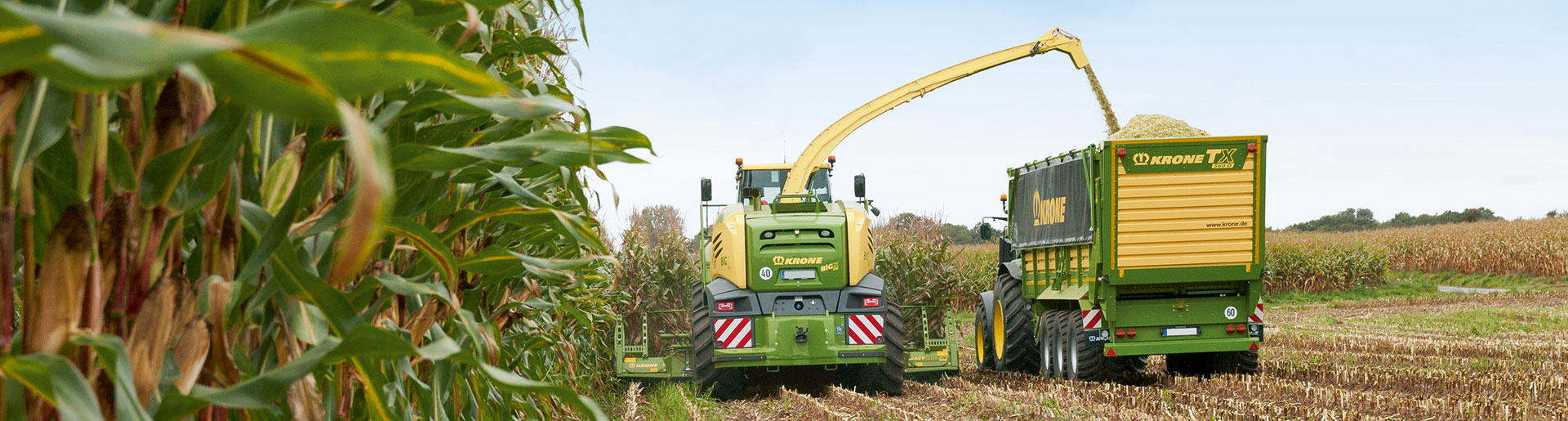


KRONE forage harvesters deliver outstanding chop quality, powerful harvesting technology and innovative solutions for professional use. With its BiG X forage harvesters, KRONE offers high-performance agricultural machinery for a wide range of forage harvesting requirements. The product range extends from compact forage harvesters for versatile operating conditions to particularly powerful machines for maximum harvesting capacity. With engine outputs from 490 to 1,156 metric hp, KRONE offers the right machine for different harvesting tasks and farm sizes.
Chop quality and continuous crop flow
When harvesting grass, maize and other crops, high output must go hand in hand with consistent, outstanding chop quality and continuous crop flow. To achieve this, KRONE BiG X forage harvesters combine six feed rollers with MaxFlow chopping drums and the VariStream system. Both the drum floor and the rear wall of the crop accelerator are spring-loaded to support a continuous crop flow, while a choice of chopping drums provides the right chop length and the best forage quality for every user.
OptiMaize for maize harvesting
With OptiMaize, KRONE offers a flexible chopping concept for maize harvesting that meets different forage quality requirements. Depending on the chopping drum and crop processing setup, chop lengths of 3 to 30 mm are possible. VariLOC extends the chop length range by changing the drum speed. OptiMaxx roller conditioners with roller diameters of up to 305 mm deliver intensive kernel processing and the highest CSPS (Corn Silage Processing Score), while maintaining maximum throughput. This allows BiG X forage harvesters to be flexibly configured to meet the different requirements of biogas production, beef finishing and dairy farming.
KRONE BiG X for different harvesting requirements
The combination of high engine power, carefully engineered chopping technology, convenient operation and the best manoeuvrability on the market makes the BiG X a versatile agricultural machine for demanding harvesting tasks. A range of models and equipment options enables farms and agricultural contractors to select a forage harvester that matches their output requirements, harvesting methods and applications. Agricultural machinery made in Spelle, a passion for forage harvesting and continuous innovation shape the development of KRONE forage harvesters.
Service, spare parts and accessories for forage harvesters
KRONE Service and Parts provides users with spare and wear parts, as well as suitable accessories for their forage harvesters. Spare parts are available through the KRONE dealer and service network. This keeps the machines reliably ready for work throughout the harvest and maintains forage harvester performance over the long term.
What is the difference between a forage harvester and a combine harvester?
The main difference lies in the harvesting process and the crop harvested: a forage harvester chops the plants it collects and transfers the chopped material to a transport vehicle travelling alongside, for example. It is primarily used to harvest grass and maize for silage or biogas. A combine harvester, on the other hand, mainly harvests crops that require threshing, such as cereals, separating the grain from the straw and other plant material. While the focus of a forage harvester is therefore on chopped plant material, the main product harvested by a combine is usually the grain.
How does a forage harvester work?
A forage harvester collects crops such as grass or maize using a suitable header and feeds them evenly into the machine. Feed rollers convey the plant material to the chopping drum, where rapidly rotating knives chop the crop to the required length. The length of cut can be adjusted to suit the crop and its intended use. When harvesting maize, the chopped material can also pass through a corn conditioner. This processes the crop intensively and, in particular, ensures that the maize kernels are thoroughly cracked. The chopped material is then accelerated and conveyed through the discharge spout directly into a transport vehicle travelling alongside. From there, it is taken to a clamp silo or biogas plant, for example. By combining several operations, a forage harvester delivers high harvesting performance and consistent results.
Which crops can be harvested with a forage harvester?
Forage harvesters are mainly used to harvest grass, wholecrop silage and maize. The forage harvester is fitted with a suitable header for the crop and harvesting method. For the BiG X, KRONE offers EasyFlow pick-ups, row-independent maize headers and XDisc direct cutting headers, among other options. This allows the machine to be adapted to different harvesting methods and crop stands.
Which headers does a forage harvester need for maize, wholecrop silage and grass?
For grass that has already been mown and laid in swaths, a forage harvester generally uses a pick-up to lift the crop from the ground. Maize is harvested with dedicated maize headers that cut the standing plants and feed them into the harvester. For the BiG X, KRONE offers EasyFlow pick-ups and the row-independent EasyCollect and XCollect maize headers, for example. XDisc direct cutting headers are also available for harvesting wholecrop silage.
Which length of cut is suitable for dairy cattle, bull finishing or biogas?
The appropriate length of cut depends on the intended use of the maize and, when used as feed, on the composition of the ration. The KRONE OptiMaize concept distinguishes between four ranges: OptiMaize S at 4–7 mm for short-chopped maize for energy production, OptiMaize M at 8–10 mm for applications including bull finishing and grass-based dairy rations, OptiMaize L at 11–19 mm for dairy rations with greater structural fibre content, and OptiMaize XL at 20–30 mm for particularly long lengths of cut. Alongside the length of cut, intensive crop processing is crucial.
What affects a forage harvester’s chopping quality?
Chopping quality is influenced by several factors. These include even crop feeding and pre-compression, the selected length of cut, the number and condition of the knives, and the correct adjustment of the chopping drum and shearbar. With maize, intensive processing of the kernels and the rest of the plant is also important. On the KRONE BiG X, the intake system, chopping drum, VariStream and corn conditioner are therefore coordinated to ensure a continuous crop flow and uniform processing.
Why is a uniform length of cut important?
A uniform length of cut is essential for homogeneous chopped material and its intended subsequent use. In silage production, the length of cut affects factors such as the structure of the forage and how well it can be compacted in the silo. The length of cut should also suit its intended use, for example in a feed ration or as a biogas substrate. Modern forage harvesters therefore allow the length of cut to be adjusted precisely.
Why do maize kernels need to be processed during chopping?
Maize kernels should be thoroughly broken or cracked during chopping to make the nutrients they contain more readily available. To achieve this, the chopped material passes through a corn conditioner during maize harvesting. On the KRONE BiG X, OptiMaxx roller conditioners perform this task, cracking the kernels and thoroughly shredding the plant material into fibres.
How much power should a forage harvester have?
The engine power required by a forage harvester depends on factors such as the quantity to be harvested, area output, crop, header and the farm’s or contractor’s operational requirements. There is therefore no single ideal horsepower rating. With the BiG X, KRONE covers a broad power range: the compact BiG X 480 to 630 models deliver 490 to 653 hp (metric), while the larger BiG X 680 to 1180 models deliver 687 to 1,156 hp (metric). This allows a machine to be selected to suit the required power and throughput range.
What distinguishes the smaller and larger KRONE BiG X forage harvesters?
The two KRONE BiG X series differ primarily in engine power and the dimensions of the chopping unit. The BiG X 480 to 630 models deliver 490 to 653 hp (metric) and feature a 630 mm wide chopping drum. The larger BiG X 680 to 1180 models deliver 687 to 1,156 hp (metric) and have an 800 mm wide chopping drum. Both series feature six feed rollers and can be equipped with MaxFlow chopping drums, VariLOC, VariStream and OptiMaxx, among other options.
What advantages does KRONE VariStream offer during chopping?
KRONE VariStream supports a continuous crop flow through the forage harvester. Both the floor beneath the chopping drum and the backplate of the crop accelerator are spring-loaded. This allows the system to respond to varying crop volumes and maintain the crop flow even when feeding is uneven. It supports high throughput and reduces the risk of interruptions to the crop flow.
How does the KRONE OptiMaxx roller conditioner work?
The KRONE OptiMaxx roller conditioner feeds the chopped maize between two profiled rollers operating at different speeds. The inclined teeth of the roller profile create a shearing effect that thoroughly cracks the maize kernels and shreds the plant material into fibres. Depending on the version, rollers with a diameter of 250 or 305 mm are available; the speed differential can be up to 50%. This allows the processing intensity to be adapted to different lengths of cut and operating conditions.