

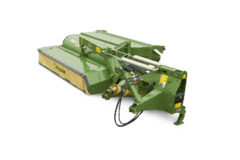
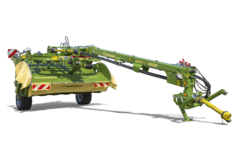
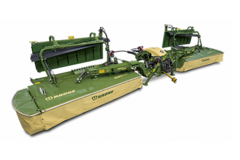
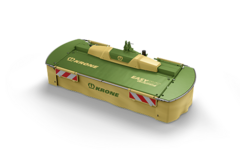
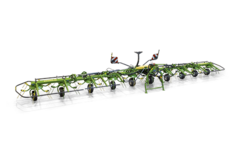
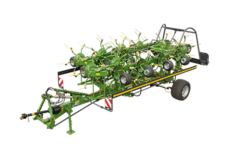
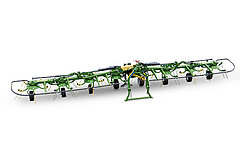
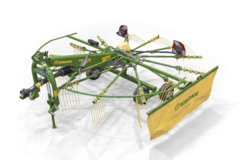
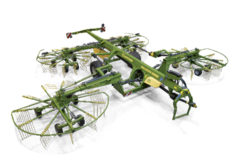
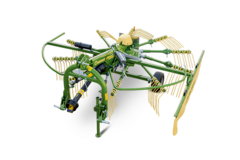














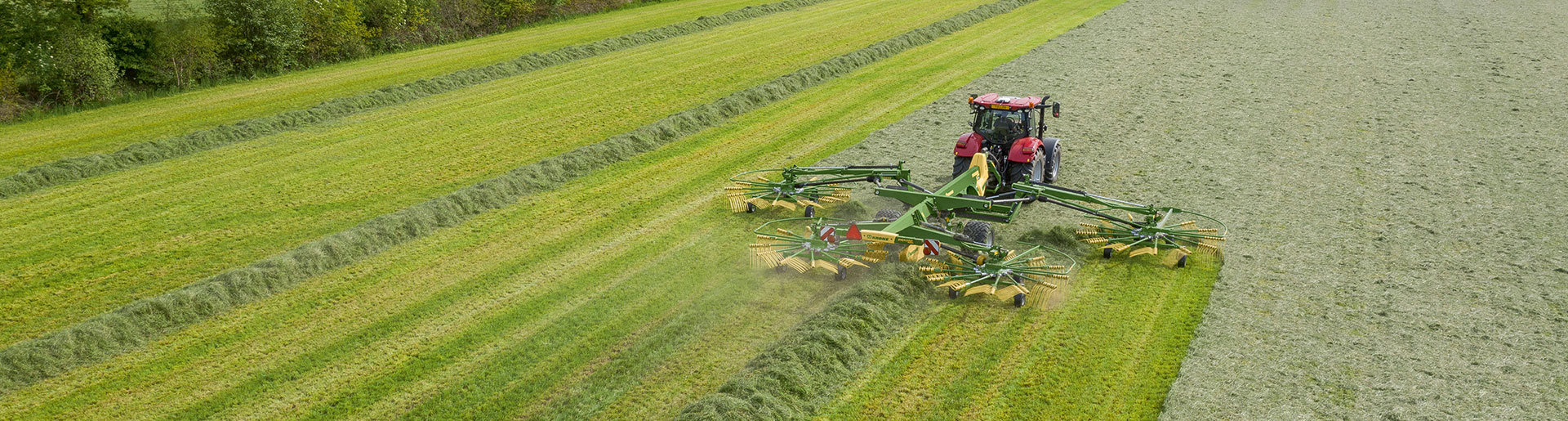


KRONE rotary rakes stand for clean crop pick-up and swath formation, high forage quality and high-performance agricultural machinery for forage harvesting. With its Swadro rotary rakes, KRONE offers the right machine for different farm sizes, field layouts and harvesting tasks. The range extends from compact single-rotor rakes to powerful multi-rotor rakes with wide working widths. Depending on the application, rakes with side or centre delivery are available. This allows the crop to be gathered into uniform swaths and optimally prepared for the machines that follow in the harvesting chain.
Rotary rakes with side or centre delivery
The Swadro S and TS side-delivery rotary rakes cover working widths from 3.80 to 9.70 m. The range extends from the single-rotor Swadro S 380 to the three-rotor Swadro TS 970. The Swadro TC centre-delivery rotary rakes are available with two, four or six rotors. Working widths range from 5.70 to 19.00 m – from the Swadro TC 640 for smaller fields and hilly regions to the Swadro TC 2000 Pro for high harvesting capacity and area output.
Ground contour following for clean raking
The ability of the rotors to follow the ground contour plays an important role in raking. The trailed, gimbal-mounted rotor suspension on KRONE Swadro rakes allows the rotors to follow the ground contour both lengthways and sideways. The KRONE Jet Effect prevents the tines from digging into the ground when the rotors are raised or lowered. This reduces damage to the sward and forage contamination. KRONE Lift tines lift the crop rather than drag it across the ground. This promotes high raking quality and helps reduce forage contamination and raking losses.
Uniform swaths for the next stages of harvesting
Depending on the harvesting machinery that follows, the crop can be placed in swaths of different widths and corresponding shapes. Whether a forage harvester, forage wagon or baler is used, the rotors place the crop so that the next machine can pick it up efficiently. Uniform swaths ensure a continuous crop flow and help maintain an even load on the following harvesting machine. They also provide favourable conditions for consistent cutting quality during further processing of the crop. Large swaths, for example, can help make optimum use of a forage harvester’s available capacity. The rotary rakes thus complement KRONE’s agricultural machinery, from mowing with disc mowers through raking to subsequent crop collection.
KRONE Swadro: technology for forage harvesting
With a variety of products, working widths and equipment options, KRONE offers rotary rakes for a wide range of forage harvesting requirements. Robust, maintenance-free rotor gearboxes, the DuraMax cam track and the Easy-Line drive concept are designed for high operational reliability, performance and a long service life. Suitable accessories allow the rakes to be further adapted to individual requirements. In this way, KRONE combines a passion for agricultural machinery, quality made in Spelle and continuous innovation with the aim of offering the right machine for different harvesting tasks.
How does a rotary rake work?
A rotary rake gathers mown and wilted crops such as grass or hay into even swaths. One or more rotors fitted with tine arms and tines rotate above the ground. The tines pick up the crop and move it towards the side or centre of the machine, where a swath is formed. This can then be picked up by a forage harvester, forage wagon or baler. For a clean result, the rotors must follow the ground contours closely and the tines must collect as much of the crop as possible without unnecessarily penetrating the soil. This helps reduce forage losses and contamination.
How can forage contamination be avoided when raking?
Forage contamination during raking can be reduced primarily through good rotor ground contouring and the correct working height. The tines should pick up the crop reliably while making as little contact with the soil as possible. The smaller the rotor, the better it can follow the ground contours.
On KRONE Swadro rotary rakes, the cardanic rotor suspension helps the rotors follow the ground contours evenly. The KRONE Jet Effect also prevents the tines from digging into the soil when the rotors are raised or lowered. KRONE Lift Tines lift the crop rather than dragging it across the ground. This can reduce the amount of soil entering the forage and help preserve forage quality.
Which is better: a belt merger or a rotary rake?
Whether a belt merger or a rotary rake is more suitable depends on the crop and the farm's requirements. A rotary rake uses rotating rotors and tines to gather the crop into a swath. Rotary rakes are versatile, available in various working widths and offer high work rates. A belt merger, by contrast, first lifts the crop from the ground with a pick-up and then transports it to the swath on conveyor belts.
This approach is particularly useful for delicate, leafy crops such as lucerne. Here, the aim is to retain as many nutrient-rich leaves as possible and reduce leaf shatter losses.
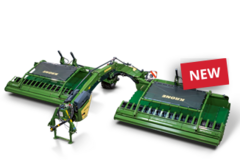
The KRONE Swativo is specifically designed for this purpose: the crop is picked up gently, transferred in a controlled manner and deposited evenly by the conveyor belts. The system also offers flexible swath placement. The best choice of swathing system therefore depends primarily on the crop, working conditions and the farm's requirements.
What makes KRONE Swadro rotary rakes stand out?
KRONE Swadro rotary rakes are designed for high swath and forage quality, effective ground contouring and reliable performance in forage harvesting. The range includes side delivery and centre delivery models, with working widths suited to everything from small fields to high-output operations. Technical features such as the cardanic rotor suspension and the KRONE Jet Effect help guide the rotors while protecting the ground. KRONE Lift Tines lift the crop and help reduce forage contamination and losses. Low-maintenance or maintenance-free components, such as the DuraMax cam track and KRONE rotor gearboxes, are also used. The KRONE EasyLine drive concept is additionally used on the twin-rotor side delivery rake and on three-, four- and six-rotor rakes. Here, the front rotors run at a higher speed than the rear rotors. This initially spreads the crop across a wider area without forming a swath. Only the following rotor forms the final swath. The result is a particularly loose, even swath that provides ideal conditions for the subsequent harvesting operations.
What is the difference between side delivery and centre delivery on a rotary rake?
On a centre delivery rotary rake, the rotors move the crop towards the centre of the machine and gather it into a central swath. A side delivery rake deposits the crop alongside the machine. Depending on the machine and how it is used, side delivery can also combine several working widths into one larger swath.
The most suitable delivery arrangement depends on factors such as field layout, forage volume and the harvesting equipment that follows. KRONE offers side delivery rotary rakes in the Swadro S and TS ranges and centre delivery rotary rakes in the Swadro TC range.
What working widths do KRONE Swadro rotary rakes offer?
The KRONE Swadro range offers various working widths for different farm sizes and working conditions. Swadro S and TS side delivery rotary rakes cover working widths from 3.80 to 9.70 m. Swadro TC centre delivery rotary rakes offer working widths from 5.70 to 19.00 m.
This provides suitable models both for smaller fields and for farms requiring high work rates and harvesting capacity. The working width should be selected to suit factors such as field size, the available tractor, forage volume and the rest of the harvesting chain.
How do you set up a rotary rake correctly?
The correct tine working height is particularly important for a clean raking result. The tines should pick up as much of the crop as possible without unnecessarily disturbing the sward. Setting them too low can introduce soil into the forage and damage the sward. Setting them too high can leave crop behind in the field.
In addition to working height, the lateral rotor tilt is important. It should be adjusted so that the crop is picked up cleanly and moved evenly into the swath. The swath width should also suit the forage volume and the harvesting machine that follows. Forward speed should be selected to ensure clean pick-up and even crop placement. The aim is a loose, even swath suited to the subsequent harvesting equipment.
How do KRONE Swadro rotary rakes follow the ground contours?
On KRONE Swadro rotary rakes, the cardanic rotor suspension helps the rotors adapt to different ground contours. It allows them to move largely independently of the main frame and follow uneven ground. Depending on the model, suitably designed rotor running gears provide additional support for close ground following.
This allows the tines to maintain as consistent a working height as possible, even on uneven fields. It helps ensure thorough forage pick-up while avoiding unnecessary soil contact and the resulting forage contamination.
What is the KRONE Jet Effect?
The KRONE Jet Effect helps control the raising and lowering of the rotors. When a rotor is raised, its front section lifts first. When it is lowered, the rear touches down first, similar to an aircraft taking off and landing.
This prevents the tines from digging into the soil when the rotors are raised or lowered. It protects the sward and helps reduce the amount of soil entering the crop.
What are KRONE Lift Tines and what benefits do they offer?
KRONE Lift Tines are specially shaped tines on Swadro rotary rakes. Their shape lifts the crop during raking rather than dragging it across the ground. The forage is then guided into the swath.
This can reduce the crop's contact with the soil. It supports clean forage pick-up, reduces contamination and losses, and helps create a loose, even swath.
How does swath shape affect the harvesting equipment that follows?
The width, height and uniformity of a swath affect how well a forage harvester, forage wagon or baler can pick up the crop. An evenly shaped swath suited to the machine that follows supports a continuous crop flow and as consistent a machine load as possible.
The swath shape should therefore be matched to the forage volume and the subsequent harvesting equipment. Depending on the harvesting machine and working conditions, a narrower or wider swath may be appropriate.
What is the KRONE EasyLine drive concept?
With the KRONE EasyLine drive concept, the front rotors run at a higher speed than the rear rotors. The front rotor therefore initially spreads the crop across a wider area without forming the final swath. Only the following rotor forms the finished swath.
This means the rear rotor does not have to rework an already formed swath. The result is a loose, even swath. KRONE uses EasyLine on the twin-rotor side delivery rake and on three-, four- and six-rotor rakes.
What is the DuraMax cam track?
The DuraMax cam track controls the movement of the tine arms within the rotor. It determines when the tines pick up the crop, move it towards the swath and then lift out of the forage again. The cam track is therefore an important component for controlled forage pick-up and even swath formation.
On KRONE Swadro rotary rakes, the DuraMax cam track is designed for a long service life and low maintenance requirements. It therefore contributes to reliable raking performance.
Why is an even swath important for the rest of the harvesting chain?
An even swath provides good conditions for a forage harvester, forage wagon or baler to pick up the crop continuously. Large variations in swath width, swath height or forage volume can lead to an uneven crop flow and affect the utilisation of the machine that follows.
Raking therefore has a direct impact on the rest of the harvesting chain. An even swath suited to the subsequent equipment can help make better use of the available machine capacity and support a continuous harvesting process.
What is the optimum forward speed when raking?
The optimum forward speed when raking depends on forage volume, crop type, ground conditions and the required swath quality. There is therefore no single speed that suits every situation. What matters is that the tines collect as much of the crop as possible and form an even, loose swath.
With large forage volumes or uneven fields, a lower forward speed may be appropriate. If crop is left behind, the swath becomes uneven or the rotors can no longer follow the ground contours accurately, the speed should be adjusted accordingly. The aim is the highest possible work rate without compromising swath or forage quality.