















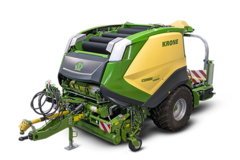
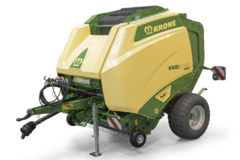
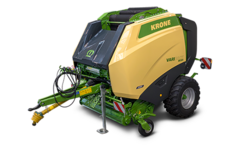



















KRONE round balers stand for high bale densities, bales that retain their shape and powerful technology for forage harvesting. Whether for silage, hay or straw, KRONE offers round balers for a wide range of requirements on farms and in contracting businesses, with different series, baling chambers and equipment options. The product range extends from compact balers with a straightforward design to high-performance baler-wrapper combinations that bale and wrap in a single operation.
Round balers with fixed semi-variable and variable chambers
Depending on the required bale size and application, round balers are available with fixed, semi-variable or variable baling chambers. In a fixed chamber, the bale diameter is determined by the design. Semi-variable chambers offer several predefined bale diameters, while variable chambers allow particularly flexible adjustment of bale size. The Comprima range, for example, covers a fixed bale diameter of 1.25 m, semi-variable bales from 1.25 to 1.50 m and variable bale diameters from 1.00 to a maximum of 1.80 m.
From the swath to a round bale that retains its shape
Uniform crop intake is the foundation of the baling process. Different pick-up and feed systems are used depending on the series. On KRONE round balers, the EasyFlow pick-up collects the swath. Feed and cutting rotors then convey the crop into the baling chamber. Models equipped with a cutting system can process the forage before baling. On Comprima, for example, a feed or cutting rotor with a diameter of 530 mm ensures high throughput, while the precision cutting system is designed for accurate cutting with low power requirements.
Inside the baling chamber, the collected crop is continuously rotated and compressed until the required bale diameter and the preset bale density are reached. Bale size and density can be adjusted depending on the baling system, crop and intended use. Smaller round bales, for example, are often used for grass silage, while larger bales can offer advantages for hay and straw. Variable baling systems also allow the baling pressure to be adjusted to different requirements, such as high density or a softer bale core for hay.
Net binding film binding and baler-wrapper combinations
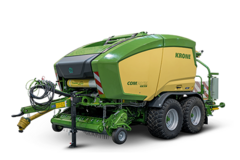
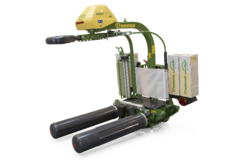
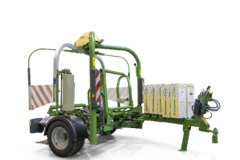
Once formed, the round bale is bound. Different binding systems are available depending on the machine and its equipment. In addition to conventional net binding, selected KRONE balers also offer film binding. In baler-wrapper combinations, the finished bale is then transferred directly to the wrapping unit and wrapped in film. This efficiently combines baling and wrapping, particularly when harvesting silage. On the ComPack Pro, the baler-wrapper combination operates automatically according to the selected settings for baling pressure, bale diameter and wrapping.
KRONE round balers for different requirements
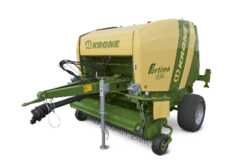
The KRONE range covers different performance and application requirements. Bellima offers a compact, robust entry into round baling, while Fortima is available with fixed and variable baling systems. Comprima combines fixed, semi-variable and variable chamber solutions within one series. ComPack Pro complements the range with robust standalone balers and baler-wrapper combinations featuring semi-variable or fully variable baling chambers. VariPack and VariPack Pro are designed for high throughput and variable bale sizes. VariPack Pro, for example, can produce round bales with diameters from 0.80 to 1.65 m or 1.90 m, depending on the model.
For particularly demanding requirements in terms of throughput and bale density, CombiPack HDP complements the portfolio. Its fully variable baling chamber allows bale diameters from 1.00 to 1.65 m. A heavy-duty single belt is designed to achieve high bale density and a uniform bale shape; its wide, closed surface is also intended to reduce crop losses. A cutting system, net and film binding, and an integrated wrapping unit complete the machine.
With different baling systems, bale sizes, cutting systems and binding and wrapping technology, KRONE offers round balers for a wide range of requirements in professional forage harvesting. From compact balers to high-performance baler-wrapper combinations, the focus is on quality, innovation and reliable agricultural machinery, delivering bales that retain their shape and efficient harvesting of silage, hay and straw.
How does a round baler work?
A round baler picks up the crop from the swath using the pick-up and feeds it into the bale chamber. Here, the material is continuously formed into a round bale and compressed until the required bale diameter and the set bale density are reached. The bale is then bound and ejected from the chamber. In a baler-wrapper combination, it is first transferred directly to the wrapping unit and wrapped in film.
What types of round balers are available?
Round balers differ primarily in the design of their bale chamber. There are fixed-chamber, semi-variable-chamber and variable-chamber round balers. Fixed-chamber balers produce bales with a diameter determined by the chamber design, semi-variable-chamber balers offer several predefined bale sizes, and variable-chamber balers allow stepless adjustment of the bale diameter within a specified range. Round balers are also available as stand-alone machines or as baler-wrapper combinations.
What is the difference between a fixed-chamber baler and a variable-chamber round baler?
In a fixed-chamber baler, the bale diameter is determined by the size of the bale chamber. A variable-chamber round baler, on the other hand, allows different bale diameters within a specified range. This provides greater flexibility to adapt the bale size to the crop and operating conditions. For example, the fixed bale diameter of the KRONE Comprima is 1.25 m, while the variable-chamber models can produce bales from 1.00 to 1.50 m or 1.80 m, depending on the version.
What is a semi-variable-chamber round baler?
A semi-variable-chamber round baler combines the relatively simple design of a fixed chamber with the option to select different bale diameters. Unlike a fully variable-chamber baler, however, the diameter is adjusted in predefined sizes rather than steplessly. The KRONE Comprima F 155, for example, offers six bale diameters from 1.25 to 1.50 m in 5 cm increments.
What is a baler-wrapper combination, and when is it a worthwhile choice?
A baler-wrapper combination brings together a round baler and a wrapping unit in a single machine. After baling and binding, the bale is automatically transferred to the wrapping table, where it is wrapped in film. This type of combination is particularly attractive to farms and agricultural contractors that regularly produce silage bales and want to combine baling and wrapping efficiently in one operation. With the KRONE Comprima, for example, the next bale can already be formed while the previous bale is being wrapped.
What is the difference between net binding and film binding?
With net binding, the finished round bale is bound and stabilised using bale net. With film binding, film performs this function. Film binding should not be confused with the subsequent wrapping of a silage bale: it binds the bale inside the bale chamber, whereas a wrapping unit then wraps the bound bale externally in stretch film. On the KRONE Comprima and ComPack, net binding is standard, while film binding is available as an option depending on the version.
How does bale density affect the storage and transport of round bales?
Increasing bale density allows more crop to be compressed into a bale of comparable dimensions. Dense bales that retain their shape can therefore offer advantages for transport and storage. However, depending on the crop, maximum compression is not always the desired result. The KRONE ComPack, for example, can be set to produce a softer core for subsequent drying or a high bale density for longer transport distances.
How many bales can a round baler produce per hour?
The number of round bales that can be produced per hour depends on factors such as bale size, crop, swath size, forward speed, the binding process and operating conditions. This means there is no universally applicable figure for bales per hour. The specific round baler and its equipment also influence the potential throughput.
What bale diameters are possible with KRONE round balers?
The available bale diameters vary according to the KRONE range and baling system. The choice extends from fixed bale sizes to wide variable adjustment ranges. The Bellima, for example, produces round bales with a diameter of 1.20 m, while the VariPack and VariPack Pro offer bale diameters from 0.80 to 1.65 m or up to 1.90 m, depending on the model.
What sets KRONE round balers apart?
KRONE round balers stand out for their high bale densities, bales that retain their shape, high throughput and robust, easy-to-maintain technology. Different baling systems are used depending on the range, such as the NovoGrip slat-and-chain conveyor on the Comprima or belt systems on the VariPack. These are complemented by a high-performance pick-up, precise cutting units and a choice of fixed, semi-variable or variable bale chambers.
“KRONE round balers deliver high bale density and throughput, bales that retain their shape, robust technology and straightforward operation and maintenance. Different baling and chamber systems are available for silage, hay and straw to suit the application.”